-
01Introduction to the Republic of Korea
-
02Multicultural Families and Foreigner Support Services
-
03Residence and Naturalization
-
04Korean Culture and Life
-
05Pregnancy and Childbirth
-
06Education of Children
-
07Health and Healthcare
-
08Social Security System
-
09Employment and Labor
-
10References
-
Chapter Introduction Video
-
FAQ
-
Status of family centers
-
Current Status of Danuri Helpline
-
Migrant Background Youth Support Foundation
-
Current Status of Saeil Center (New Job Center for Women)
-
Immigration Offices
-
Major Tourist Destinations by Region
-
Contact Numbers for Key Foreign Embassies and Consulates in Korea
-
Guide to Personal Information Protection
-


Danuri Call Center : 1577-1366
가족상담전화 : 1644-6621


21F, 173, Toegye-ro, Jung-gu, Seoul (Chungmuro 3-ga, Namsan Square Building)
Copyright ⓒ KOREA INSTITUTE FOR HEALTHY FAMILY. All Rights Reserved
Middle School Education
- Home
- Education of Children
- Middle School Education
Middle School Education
The middle school curriculum is a three-year curriculum. Students are assigned to schools by lottery in each region and school group. For areas in which commuting is extremely inconvenient, the schools to attend are assigned according to the middle school groups designated by the superintendent of education. Likewise with elementary school, middle school education is mandatory and free. Parents who do not send their children to middle schools are subject to fines.
01Curriculum
Middle school education consists of subject learning and creative experiential activities. It builds on the achievements of elementary education, and aims to develop the basic abilities necessary for students’ daily lives and learning while cultivating sound character and democratic citizenship. Students learn subjects such as Korean language, social studies (including history)/moral education, mathematics, science/technology and home economics/informatics, physical education, arts (music/art), and English. Students take about eight subjects each semester. Creative experiential activities are extracurricular activities where students apply and put into practice what they have learned in curricular activities. Through discretionary and self-governing activities, club activities, and career activities (in the case of grades two and three, discretionary activities, club activities, volunteer activities, and career activities), students establish their self-identity, enhance their attitude towards living with others, and develop the ability to actively explore their career paths. Classes in middle school are 45 minutes long, and typically, schools have six or seven periods a day. Middle schools, unlike other school levels, operate the Free Semester Program and school sports club activities. One semester of grade one in middle school is used for the Free Semester Program, where students participate in various career exploration activities to discover their aptitudes and design their future. School sports club activities offer a variety of sports chosen by students to improve their physical fitness and provide diverse physical activity opportunities. Club activities take up 34 to 68 hours per year depending on the grade level.
“School violence” refers to any actions committed against students on or off school grounds that cause physical or mental injury, or damage to property. These include battery, assault, confinement, threats, kidnapping, abduction, defamation, insults, extortion, coercion, forced errands, sexual violence, bullying, and cyberbullying.
- The actions listed in the definition above are only examples.
- One has a solemn facial expression and feels less energetic than usual.
- One over-reacts to even trivial things, such as being startled when calling their name, and shows more sensitivity than usual.
- There is a repulsion or fear of going to school.
- One is absent from school without reason or asks for a transfer.
- There are constant lacerations or bruises seen on the body and a desire to be left alone.
- There are drawings that express despair (e.g. I want to die) or revenge (e.g. die).
- One doesn't protest or react even when their friends gossip about them.
- One is marginalized or excluded during group activities or various activities within the class.
- During break or lunch time, one often stays in an isolated space (i.e bathroom) to avoid classmates.
- Clothes are often damaged or supplies and belongings are lost.
- One is reluctant to participate in school events or group activities.
- One is more frequently tardy, leaving early, or absent from class without any special reason.
- One often checks electronic communication devices with an anxious look and reacts sensitively.
- Being repeatedly attacked in group chat rooms.
- One asks for a lot of pocket money or incurs high charges racked up on online devices.
- One extremely dislikes and reacts too sensitively to parents touching or peeking at their electronic communication devices.
- One gets embarrassed or emotionally distressed after seeing a text message or messenger.
- In cyberspace, one is called by derogatory nicknames or profanity rather than by name, or is often ridiculed or gossiped about.
- Status updates or the mood of photos on social networking services (social medias) suddenly becoming gloomy or negative.
- Too much time is spent using computers or electronic communication devices.
- Strangers have heard stories or rumors about your child.
- One is suddenly reluctant to use their cell phones or closes any social media accounts.
On school grounds
- Verbal Report
- Report Box
- Survey
- Email
- It is also a good idea for the homeroom teacher to regularly send school violence prevention and reporting guidelines to students by email. A report form should be attached to the email so that students can reply immediately.
- Social networking services (social medias)
- Website
- Mobile Phone
- Posters
Off school grounds
- 112 National Police Agency
- 117 School Violence Reporting Center
- School Police Officer
(1)Schools
School Violence Exclusive Unit
When a child reports that he/she has suffered violence to the School Violence Exclusive Unit inside the school, the unit reports the case to the office of education within 48 hours of confirming the initial facts of victimization and perpetration. Afterwards, the school violence investigator from the office of education’s Zero School Violence Center or the School Violence Exclusive Unit and teachers meet directly with students, parents, etc., to investigate the case. The School Violence Exclusive Unit reviews whether the principal can resolve the case internally based on the investigation results. If the requirements for internal resolution are met and the victim student and his/her guardian agree, the principal may resolve the matter internally. However, if the requirements for resolution by the school principal are not met or if the victim student and his/her guardian do not agree, the school will request a review from the School Violence Countermeasures Committee established within the office of education.
- Zero School Violence Center: A dedicated department within the office of education that carries out integrated support services such as healing students who are victims of school violence, restoring relationships between victim students and perpetrator students, and providing legal advice for victim students.
- School violence investigator: A school violence investigation & counseling expert appointed and enlisted by the superintendent of education (or superintendent of education) to confirm the facts of an incident involving a victim or perpetrator of school violence.
Wee Class (school counseling center)
This primary counseling class was created for students in crisis who are experiencing difficulty with school life due to various reasons. The class provides a counseling service to assist students in adapting to school life.
(2)Office of Education
Autonomous Committee for Countermeasures against School Violence
The School Violence Countermeasures Committee is a statutory committee within the office of education that deliberates on matters related to the prevention of and countermeasures against school violence. The committee deliberates on the prevention of and countermeasures for school violence, the protection of student victims, education and guidance of student perpetrators, and dispute resolution between victim students and perpetrator students.
Wee Center (student counseling support center)
Wee Center is the secondary counseling organization established at the office of education level for students in crisis who cannot be helped by the school. The center provides one-stop services that are customized for students, and offers a combination of professional diagnosis, counseling and therapy.
Wee School
Wee School is the tertiary counseling organization established at offices of education of cities and counties for students who require long-term therapy and education due to serious crises that result in a suspension of education. It operates various counseling and therapy as well as commissioned educational services including alternative learning programs at boarding schools.
(3)Social Organizations and Enterprises
SOS Support Team on School Violence
SOS support team on school violence, operated by The Blue Tree Foundation, provides various programs such as school violence prevention, problem solving, and recovery for school violence victims and attackers, families, and schools. Call for phone counseling (☎1588-9128) or visit the website (www.btf.or.kr).
Help Call 1388 for Youth
Youth Counseling 1388 is a counseling service operated by the Ministry of Gender Equality and Family. You can consult with professional counselors 24/7, 365 days a year about various concerns, including damages caused by school violence and peer relationship issues. Available via phone (☎1388), online (www.cyber1388.kr), and text message/KakaoTalk (#1388).
Sangdami Ssam
Sangdami-ssam is a mobile counseling service that provides support for school violence-related counseling and treatment costs through a collaboration between the Ministry of Education, KB Kookmin Bank, Kakao, and the Korean Open Doctors Society. Search for “Sangdami-ssam” on KakaoTalk, add it as a friend, and send a message to consult with a professional counselor (Consultation hours: Weekdays 10:00–24:00, excluding weekends/public holidays). Support for counseling costs not exceeding KRW 800,000 will be provided to 150 or fewer students per year among victim students, perpetrator students, and students at high risk of school violence who received counseling.
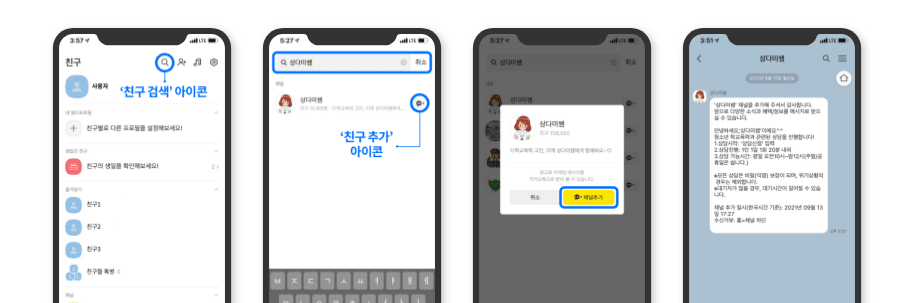
icon from Friends list.
in the search field and
click the ‘Add Friend’ icon.
when you enter ‘request
counseling’ in the chat
window.
"Wee" stands for "WE + Education", and "WE + Emotion"
-
- 1st Safe-net Wee Class
-
- Established at each schoo
- Detection and prevention of students maladjusted to schools leading them to enhance school adaptability
- Normal students or students maladjusted to school (school violence, in danger of leaving school, bullying, peer relationships, media addiction, misdeeds, etc.)
-
- 2nd Safe-net Wee Center
-
- Established by Regional Education Offices
- Customized assessing/counseling/treatment services for students in crisis
- Students in crisis referred by schools because they are having difficulty in school
-
- 3rd Safe-net Wee School
-
- Established by Education Offices of Cities and Provinces
- Commissioned educational services for students in crisis who need mid- to long-term intervention
- Students in crisis who need mid to long term treatment and Education